
Common MEA Attestation Problems and How to Avoid Them
A small error in your documents can slow down MEA attestation or force you to correct something before the process can continue.
Problems often start before the document reaches the Ministry of External Affairs. Missing authentication, mismatched details, the wrong legalization route, or an incomplete document can all create delays.
This guide looks at the common MEA attestation problems applicants face, why they happen, and what you can check before submitting your documents.
- Prior authentication
- Document mismatches
- Attestation vs Apostille
- Submission checklist
Why Do Problems Occur During MEA Attestation?
MEA attestation is usually one part of a larger document authentication process.
The Ministry of External Affairs states that documents not covered by e-Sanad generally need authentication by the designated State or Union Territory authority before they are submitted for MEA attestation or Apostille. The Ministry legalizes documents based on the signatures of these designated authorities.
This is why following a process used by someone else may not always work for your document.
Official reference: MEA Attestation and Apostille Guidelines7 Common MEA Attestation Problems and How to Avoid Them
Most MEA attestation issues fall into a few common categories. Checking these points before submission can help you avoid unnecessary corrections and resubmissions.
Skipping Required Authentication Before MEA Attestation
One common mistake is trying to send a document for MEA attestation without completing the authentication required before it.
For documents outside the e-Sanad route, MEA states that documents should first be authenticated by the designated State or Union Territory authority. Educational, personal and commercial documents can follow different authentication channels.
For example:
- Educational documents may require authentication through the designated education authority.
- Personal documents such as birth or marriage certificates may require authentication by the concerned State or Union Territory authority.
- Commercial documents are generally pre-authenticated through the relevant Chamber of Commerce.
If you are dealing with an educational certificate, check whether HRD attestation or another applicable state authentication is required before moving ahead.
Name, Date or Personal Detail Mismatches
A spelling difference that looks minor to you can become a problem when documents are being verified.
Common examples include:
- Different spellings of your name across certificates.
- Different dates of birth.
- Initials used on one document and the full name on another.
- Incorrect certificate details.
- Missing signatures or seals where they are required.
Before starting attestation, compare the document with the identification and supporting documents you plan to submit.
Submitting Damaged, Unclear or Laminated Certificates
The physical condition of a certificate matters.
Torn documents, unclear printing and damaged certificates can make verification difficult. Lamination can also create practical problems where authorities need to examine or place authentication marks on the original document.
Do not try to remove lamination yourself if doing so could damage the certificate.
Instead:
- Check whether the certificate is clearly readable.
- Look for tears, fading or missing information.
- Confirm the applicable requirement if the original is laminated.
- Get advice before attempting any physical alteration to an important original certificate.

Submitting the Wrong Document or an Incomplete Set
Sometimes the problem is not with the certificate itself. The wrong document has simply been submitted.
This can happen when an applicant:
- Sends a photocopy when another format is required.
- Submits the wrong certificate.
- Leaves out a required supporting document.
- Sends an incomplete document.
- Assumes all certificates need the same supporting papers.
For documents handled through the outsourced MEA attestation route, the Ministry states that the original document or true copy is submitted along with a photocopy of the document and a photocopy of the applicant's passport. MEA also states that it does not legalize photocopies themselves.
5. Confusing MEA Attestation, Apostille and Embassy Legalization
MEA attestation and Apostille are not interchangeable terms.
India is a party to the Hague Apostille Convention. An Apostille is used when the applicable conditions under the Convention are met. Normal MEA attestation applies to countries where Apostille is not accepted.
So, do not choose a process simply because someone you know used it for their overseas documents. The correct route depends on the destination country and what the receiving authority requires.
Apostille
For a destination where the Hague Apostille Convention applies.
Normal Attestation
For countries where Apostille is not accepted.
Embassy Legalization
When further diplomatic legalization is required by the destination.
If your destination requires an Apostille, see Atlanta's Apostille attestation services. If further diplomatic legalization is required, you may also need to understand the Embassy attestation process.
You can check the current list of parties to the Hague Apostille Convention through the official Hague Conference on Private International Law.
Official reference: HCCH Apostille Convention Status Table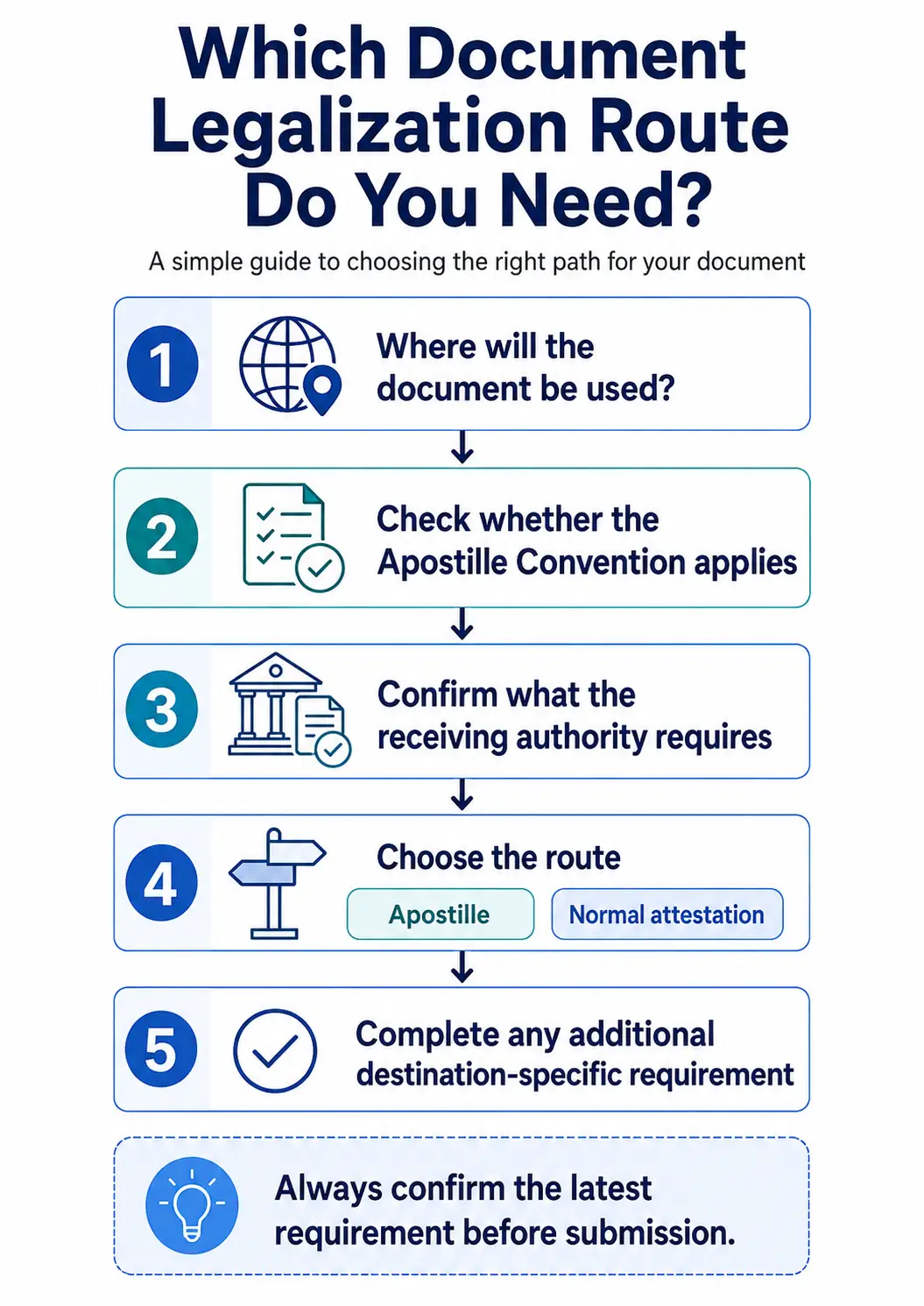
Not Checking the Destination Country's Requirements
Getting a document processed in India does not automatically mean you have completed every requirement for using it abroad.
Before you begin, know three things:
- What document are you submitting?
- Which country will you use it in?
- Why is the document being requested?
The receiving authority may have its own requirements concerning legalization, translation or supporting documents.
When in doubt, check with the organization that has requested your document. This could be an employer, university, licensing body, embassy or another authority.
Starting the Attestation Process Too Close to Your Deadline
Waiting until a visa appointment, job joining date or university deadline is approaching leaves little room for corrections.
MEA processing may not be the only stage involved. Time can also be required for:
- Prior authentication.
- Document verification.
- Correction of discrepancies.
- Additional destination-country requirements.
- Resubmission when something is incomplete.
There is no single processing time that applies to every document because the route can differ.
Be Careful When Choosing Someone to Handle Your Documents
Degree certificates, marriage certificates, birth certificates and other originals are important documents. Do not hand them over without knowing how they will be handled.
The Ministry of External Affairs specifically advises applicants not to depend on unauthorized persons or touts for attestation or Apostille services. MEA currently lists designated outsourced service providers for documents submitted through the physical route.
Before giving your documents to anyone:
- Verify the business and its contact details.
- Ask how your documents will be submitted.
- Ask for acknowledgement of the documents handed over.
- Keep receipts and submission records.
- Ask how you will receive status updates.
- Be cautious of unrealistic guarantees.
Quick MEA Attestation Checklist Before Submission
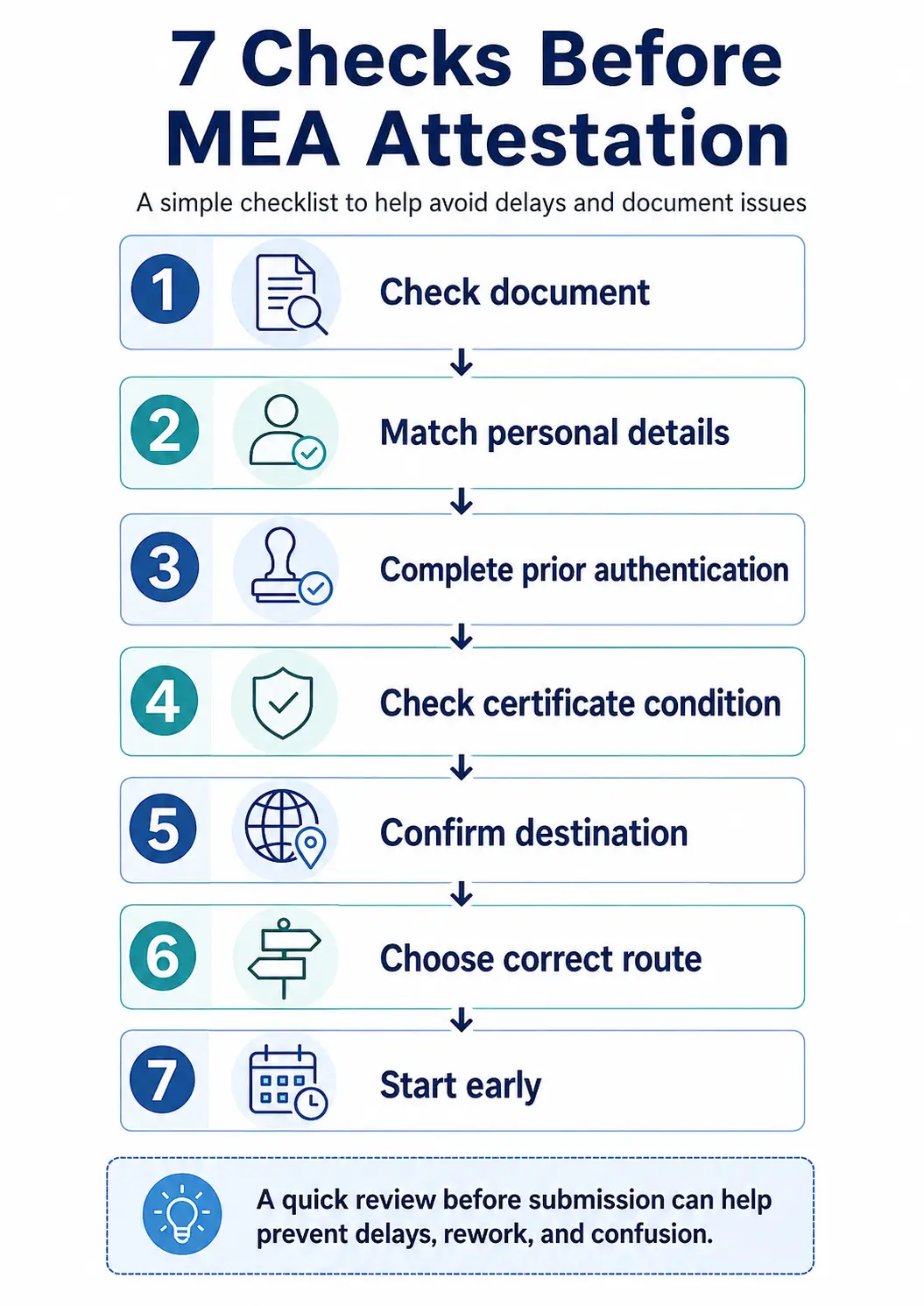
Before your documents leave your hands, run through this quick check.
Make sure you are submitting the certificate actually requested by the receiving authority.
Check names, dates, certificate numbers and other personal information.
Confirm whether authentication is required before MEA processing.
Check that the certificate is readable and not damaged.
Make sure you know which country will receive the document.
Confirm whether you need normal attestation, Apostille or additional legalization.
Do not leave the process until immediately before an important deadline.
What Should You Do If Your MEA Attestation Is Delayed or Returned?
Do not immediately submit the same documents again. First, find out where the problem occurred.
If your document is eligible for the e-Sanad system, its verification and attestation process may be handled through the digital platform. e-Sanad currently supports documents from issuing authorities that are integrated with its digital repositories.
Official reference: e-Sanad Document Attestation Portal
Need Help Checking Your MEA Attestation Requirements?
Atlanta Consultants assists professionals with MEA attestation services and related document processing.
If you are unsure about the authentication required before MEA attestation or the next step after it, speak with the team before submitting your documents.
Frequently Asked Questions About MEA Attestation
How many days does MEA attestation take?
There is no single processing time for every document because prior authentication and the submission route can differ. If you have a fixed visa, employment or admission deadline, start the process early and confirm the expected timeline for your document.
How can I verify an MEA Apostille?
MEA's e-Sanad portal provides an electronic register for verifying Apostilles. The Apostille details can be checked against the information recorded by the competent authority. Visit the e-Sanad portal.
What is the validity of MEA attestation?
MEA does not state a universal expiry period that applies to every attested document. The authority receiving your document may set its own recency or validity requirement, so check with that organization before using an older attested certificate.
What are the fees for MEA attestation in India?
According to the current MEA guidance, normal attestation itself is free, while Apostille carries an MEA fee of Rs 50 per Apostille. The official page also lists outsourced service and scanning charges, so check the latest MEA fee table before submission.
Who can get documents attested by MEA?
MEA provides attestation and Apostille services for Indian-issued personal, educational and commercial documents intended for use abroad. The route depends on the document, its issuing authority and the country where it will be used.
Can someone else handle my MEA attestation documents?
MEA uses designated outsourced service providers for receipt and delivery of documents under the physical submission route. If you use assistance from another service provider, confirm how your documents will reach the authorized submission channel and keep a record of everything handed over.
Avoid MEA Attestation Problems Before They Delay Your Plans
Most MEA attestation problems are easier to prevent than correct later.
Check the document, personal details, required authentication and destination-country requirements before you start. Most importantly, make sure you are following the right route for the country where the document will be used.
If the process is unclear, Atlanta Consultants can help you understand your document requirements and assist with MEA attestation, HRD attestation, Embassy attestation and Apostille services.